
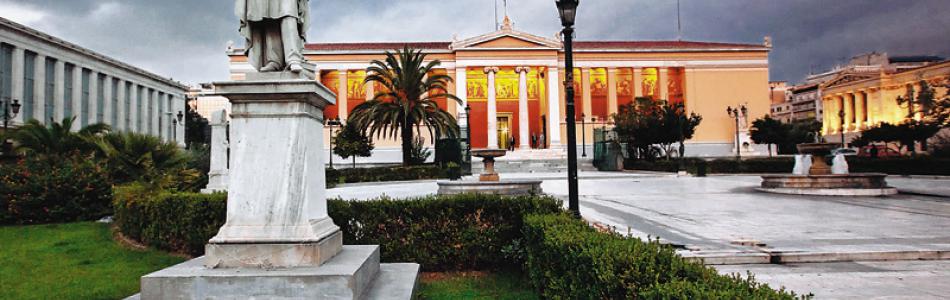

The main building of Athens University was founded in 1839, based on plans of the Danish architect Hans Christian Hansen (1803-1883) who, without deviating from the basic principles of classicism, created a composition that combines the grandeur of the monument with the simplicity of the human, indicating an attempt to adapt to the local environment. The plan is developed in a two-storey double "T" with two symmetrical courtyards on both sides, forming a rectangle. The construction of the rear wing was completed by the year 1842-1843, while the construction of the rest of the wards was continued up to the year 1864, under the successive supervision of Lysander Kaftantzoglou and Anastasios Theophilas. Othonas, the Serbian leader Milos Obrenovic, Demetrius Platygenis, Demetrius Benardakis, Ionidou brothers and the Greek community contributed financially to the completion of building. Baron Simon Sina financed the frescoes on the walls which were designed in 1861 by the Bavarian painter Karl Rahl. In front of the building, several statues were placed: Rigas (1871), the Patriarch Gregory V (1872), Adamantios Korais (1875), Gladstonas (1885) and Ioannis Kapodistrias (1928). The role of this building was important as it shaped a remarkable morphological system in Greece. The subsequent construction of the Library and the Academy, established what is now known as the Neoclassical Trilogy of Athens.
The building of the National Library was built thanks to donations of expatriates businessmen brothers, Marinos and Andreas Vallianos. It was designed by architect Theophil Hansen (1813-1891). The position of the building (on the side of the University and the future Academy) had already been decided in 1842. The library, also known as "Vallianeios" Library, was finally founded in 1887 and was completed in 1902. The composition of the building follows the Doric style, combined with Renaissance-style scales that caused controversy. It is made with Pentelic marble while sculptor George Bonanos decorated the exterior with the statues of Panagis Vallianos and his brothers. Due to financial reasons, the decorative sculptures of the pediments were not constructed.
The building of the Academy of Athens was built thanks to donations of the homogenous businessman in Vienna, Baron Simon Sina (1810-1877) and his wife Iphigenia. It was designed by Theophil Hansen (1813-1891) and supervised by Ernst Ziller (1837-1923), whose further stay in Greece proved to be decisive for the course of the Modern Greek architecture. The position of the building (on the side of the University and the future Academy) had also been decided in 1842. The Academy, also known as Sinai, was founded in 1859 and was completed in 1885. It is also built with Pentelic marble like the Library and on the sides you can see the statues of Athena and Apollo, work of sculptor Leonidas Drosis, who also designed the seated statues of Plato and Aristotle which were built after his death. Despite the completion of building, the purpose of the Academy was to remain unresolved for another forty years until 1926 with Pangalos dictatorship. In the meantime, the building remained unused, with the exception of certain areas being used by the Numismatic Museum and the General State Archives, while there was also a thought back in 1888 to use this place as a guest house for distinguished visitors.