
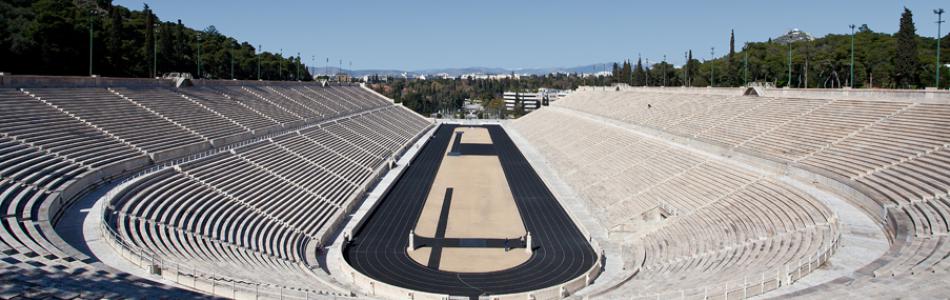
It was originally a natural cavity in the ground between two hills, Agra and Ardittos hills. It was made into a stadium by Lykourgos in 330-329 BC for the athletic competitions of the Great Panathenaic festivals. Between 140-144 AD Herod Atticus restored the Stadium in the form that was revealed in the 1870 excavation. It is U-shaped, with a total track length of 204.07 m. and a width of 33.35 m. It is estimated that it could host up to 50,000 spectators. Herodotus probably renovated Ilissos bridge at the entrance of the Stadium. He made it bigger, with three arches. It was visible until 1778 and part of it was excavated in 1958. In Roman times the stadium could be used as an arena by adding a semicircular wall at the northern side.
The latest reformation of the Stadium was made by G. Averof in the late 19th century for the first Olympic Games after their revival in 1896.